

Budget 2026: Consequences for the Indian MedTech Industry
The Union Budget 2026 marks an important moment in the growth of India’s MedTech and life sciences sectors, signalling a strategic transition from social utility to a high-growth asset class. With the healthcare allocation crossing the ₹1 lakh crore milestone for the first time, the government has devised a plan that aims to spur deep-tech manufacturing and innovation-led growth.
Deepening the "Make in India" Moat
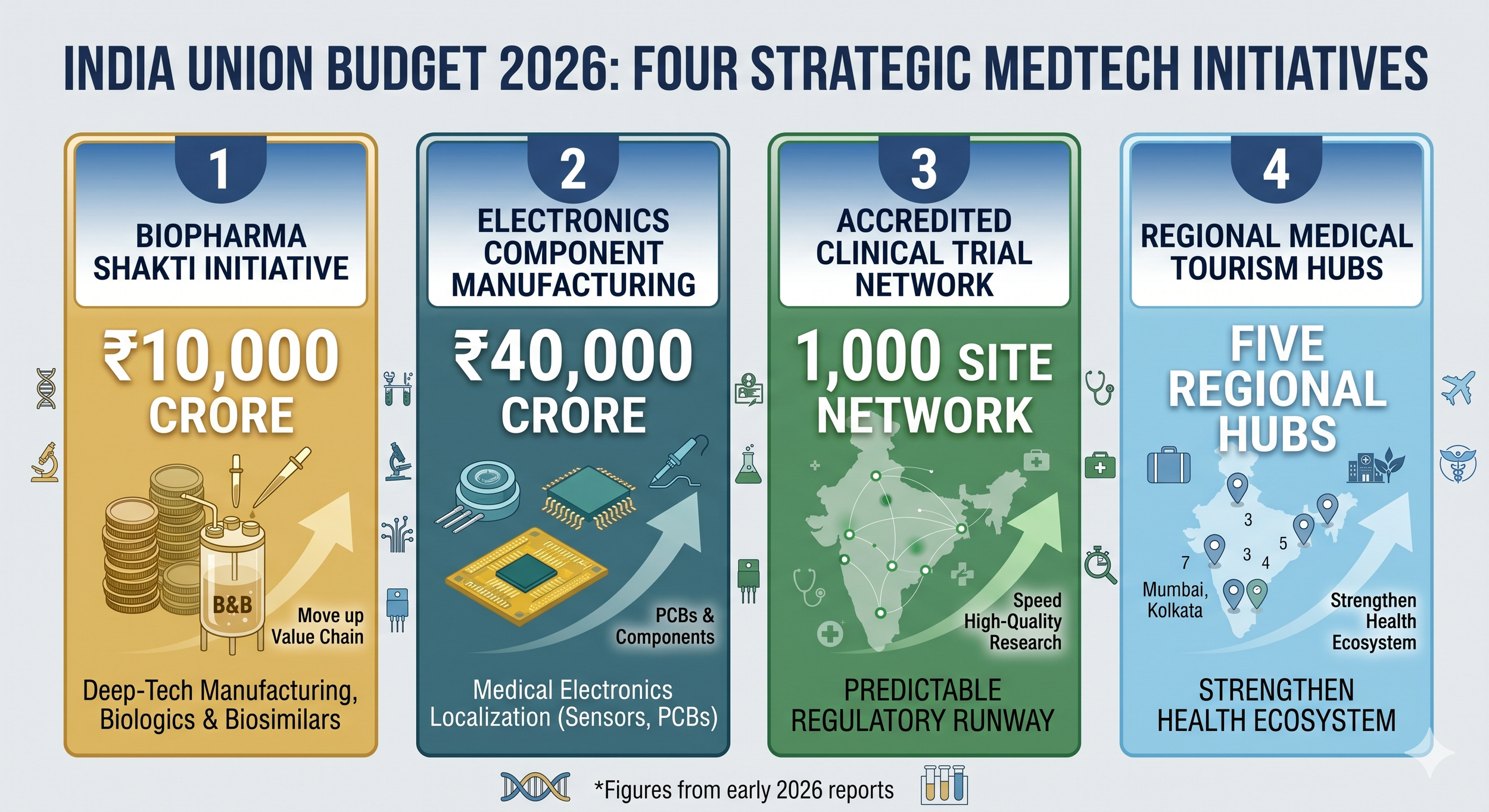
The centrepiece of the industrial strategy is the ₹10,000 crore Biopharma Shakti initiative. By focusing on biologics and biosimilars, India is moving up the value chain from volume-led generics to high-value, complex therapeutics. This is complemented by a ₹40,000 crore outlay for electronics component manufacturing, a move that will likely catalyse the evolution from the currently common “assembly-only" model in medical electronics to the establishment of integrated manufacturing hubs across the country. For diagnostic imaging and cardiovascular device players, this reduces the "inverted duty" pain and encourages the localization of high-precision sensors and PCBs.
De-Risking through Infrastructure
Investor sentiment is set to strengthen with the creation of a 1,000-site accredited clinical trial network. This infrastructure, paired with the modernization of seven NIPERs and a strengthened CDSCO, looks to provide a predictable regulatory runway that has long been missing. These measures act as vital de-risking mechanisms, encouraging long-term capital deployment in "deep science" rather than just low-tech consumables. Additionally, the proposal to establish five Regional Medical Tourism Hubs aims to position clusters like Delhi NCR as global destinations and further strengthen the health ecosystem.
The 2-3 Year Outlook
As India leverages new FTAs with the UK and EFTA, the 2026 Budget provides the domestic muscle to scale exports. We are entering a consolidation phase where the "assembly" model will fade, replaced by integrated manufacturing hubs. Expect the Indian medical device market to accelerate toward its $50 billion target by 2030, driven by a self-reliant component ecosystem and world-class clinical validation.
