

Malaria: The Disease Burden That Grows Still
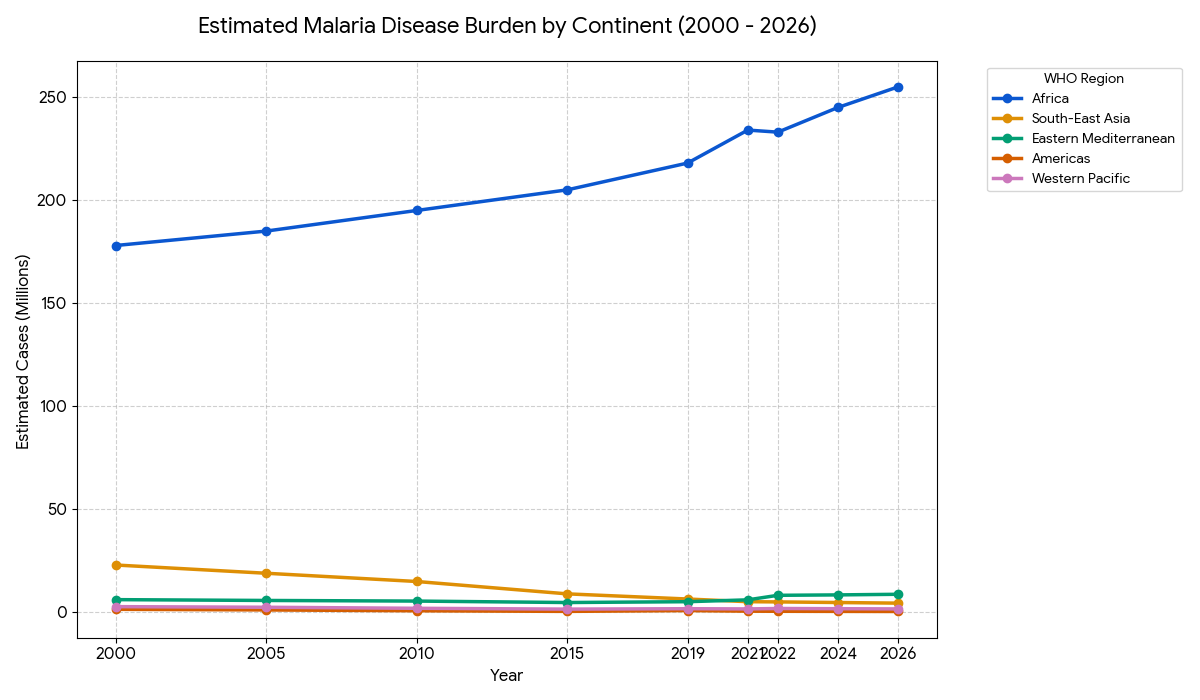
The global fight against malaria has reached a critical inflection point. Data from the WHO World Malaria Report 2025 reveals a sobering trend: global malaria cases have reached 282 million cases annually, exceeding pre-pandemic figures, with 610,000 deaths being attributed to this mosquito-borne disease. While billions of cases have been averted since 2000, progress is being challenged by biological threats, climate change, and shifting demographics.
Africa: The Structural Demand Center
Africa continues to shoulder 95% of global malaria cases and 96% of deaths. In high-burden nations like Nigeria, the DR Congo, and Ethiopia, malaria is not a cyclical spike but a structural constant. The global malaria landscape has evolved into a story of intense geographic concentration, where an impressive 80% decline in South-East Asia's burden since 2000 stands in contrast to Africa's rising case numbers, which are projected to hit 255 million by 2026 due to rapid population growth and the resilience of urban-adapted vectors. Additionally, the invasive Anopheles stephensi species of mosquito has expanded malaria into densely populated African cities, creating urban hotspots where mosquito-borne diseases now co-circulate.
For MedTech firms, this translates into a sustained, high-volume need for Rapid Diagnostic Tests (RDTs). With nearly 350–400 million RDTs distributed annually through Global Fund-supported programs, the need for decentralized, rural-ready diagnostics is an important fixture of the healthcare economy: not a cyclical public need but a structural pillar of the healthcare system.
The Multi-Pronged Policy Response
The Global Fund and WHO continue to finance a diverse intervention toolkit:
Vector Control: High-scale distribution of insecticide-treated nets (ITNs) and indoor residual spraying
Therapeutics: Access to Artemisinin-based Combination Therapies (ACTs).
Vaccine Rollout: The historic scaling of R21/Matrix-M and RTS,S/AS01 vaccines across endemic regions
Diagnostics continues to be the gateway to these interventions. Institutional procurement heavily favors WHO-prequalified suppliers who can prove heat stability (up to 45°C) in the grueling "last-mile" tropical supply chain.
The Future: Bridging the Manufacturing Gap
The long-term goal for the continent is indigenous production for therapeutics, vaccines and diagnostics, supported by the African Medicines Agency (AMA) and regional hubs in Kenya, Egypt, and South Africa. However, the path to self-sufficiency is a multi-year industrial journey.
While the African Union aims for 60% local health sovereignty by 2040, the 2026 landscape remains heavily dependent on global supply chains to bridge a massive deficit. Currently, Africa requires approximately 400 million Malaria RDTs annually, yet less than 20% are manufactured on the continent. This necessitates the importation of over 320 million units from hubs like India to sustain frontline screening.
Until African manufacturing can fully satisfy the continent's immense healthcare demands, the role of established global hubs is vital. High-quality RDTs from countries like India, Korea and China, which combine WHO-compliant manufacturing with cost-efficiency and reliable supply chains, must continue to be integrated into the system. This cross-continental supply remains essential to keep screening available, ensure diagnostic sovereignty, and prevent a collapse in the frontline fight against febrile illness.
