

The Cyber-Sourcing Threat: Navigating the Era of Medical Deepfakes
The rapid migration of healthcare toward a fully digital frontier promises a new era of clinical precision. Using AI-augmented workflows and decentralized data ecosystems, the industry is dismantling the friction of fragmented records and diagnostic blind spots. However, this high-velocity shift has birthed a sophisticated trust crisis: the erosion of digital evidence. As generative AI models achieve hyper-realistic fidelity, the MedTech world faces a daunting regulatory stress test in the form of medical deepfakes. At Roadrunner EXIM, we monitor these technological shifts to secure our partners' long-term investments: we look beyond scan speeds to audit the digital integrity of the pipeline, ensuring the technology you deploy defends patient data and institutional sovereignty against the threats of tomorrow.
A recent study in Radiology highlights a sobering vulnerability in our current screening frameworks. When presented with synthetic, AI-altered chest X-rays, veteran radiologists identified the deception just 41% of the time. Even when explicitly alerted to the presence of manipulated data, human accuracy reached a ceiling of only 75%.
The systemic implications are severe. Since generative capabilities are evolving faster than our regulatory defenses, the provenance of a digital scan is no longer a given. In a network breach, a malicious actor could theoretically inject a synthetic tumor into a CT scan or expunge a hemorrhage from an MRI. The consequences are binary and catastrophic: healthy individuals facing unnecessary invasive surgery, and critical patients left waiting for care that never arrives.
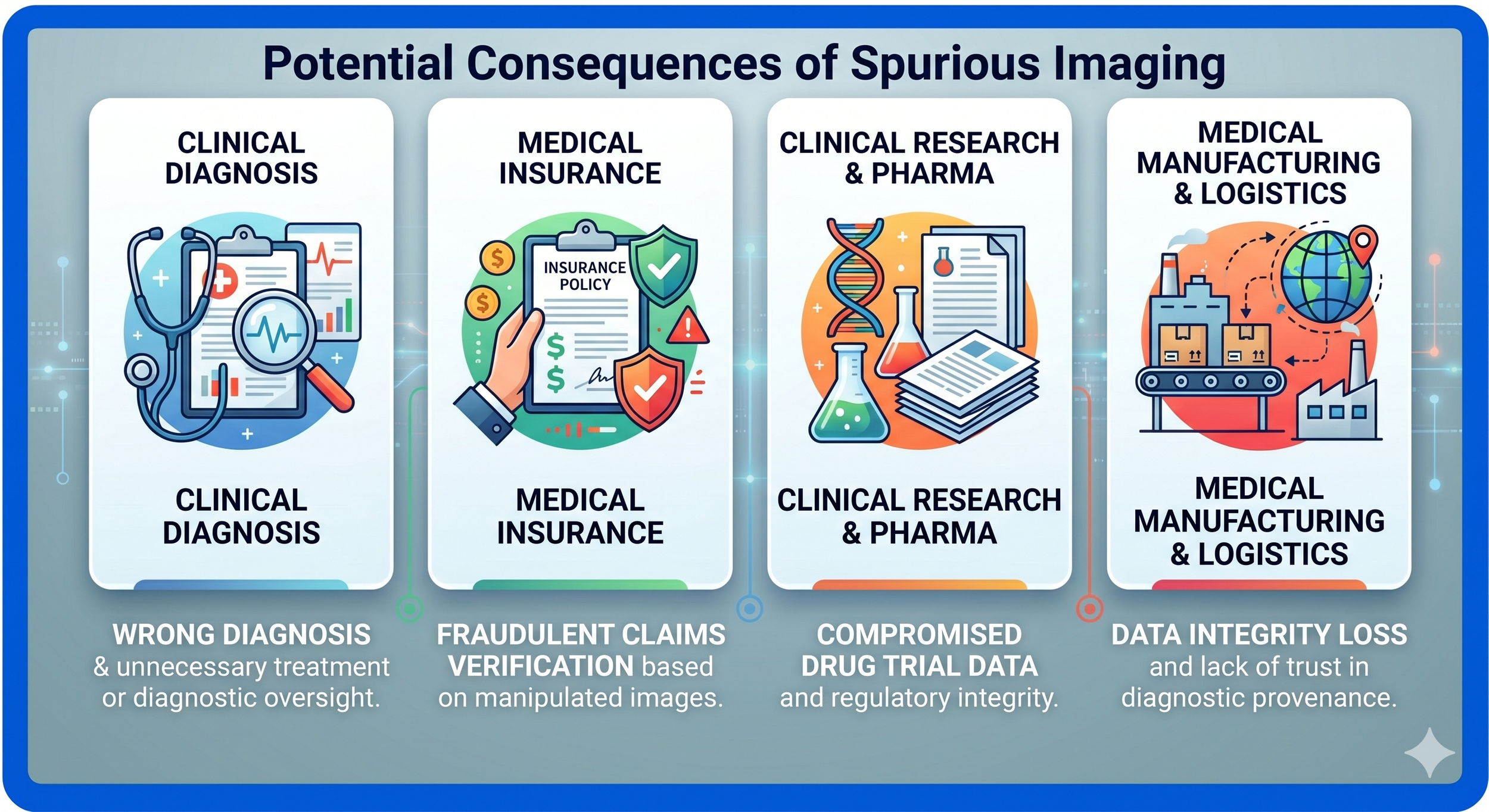
This deficit of trust extends to the very bedrock of our industry, affecting critical sectors like insurance, research, and global procurement. If a digital asset can be flawlessly forged, the foundational validity of a clinical trial comes into question. Similarly, insurance providers will struggle to verify high-cost claims in a landscape of manipulated evidence. As we grapple with these systemic risks, legacy compliance models will become obsolete.
This represents the next defining frontier for MedTech regulation. Historically, compliance focused on physical hardware and basic safety. Future mandates must pivot to ensure end-to-end digital provenance authenticity. In a decentralized world, we can no longer afford the luxury of assuming a digital file is inherently valid.
In the 2026 landscape, advanced data security features will become critical capital differentiators. When evaluating diagnostic imaging infrastructure, forward-thinking networks must prioritize systems equipped with:
Digital Signatures: Cryptographic stamps that bind to metadata the moment an image is captured.
Invisible Watermarking: Hidden security layers that flag if a single pixel has been tampered with post-capture.
Zero-Trust Architectures: Network protocols that treat every unverified file as a threat until mathematical validation is complete.
Technological shifts always bring with them the promise of innovation and progress, as well as the potential for the technology to be misused. As the world rapidly finds itself immersed in the AI age, the MedTech sector must navigate the changing conditions to ensure that diagnostic provenance and quality retains reliability.
